Wednesday, October 21, 2026

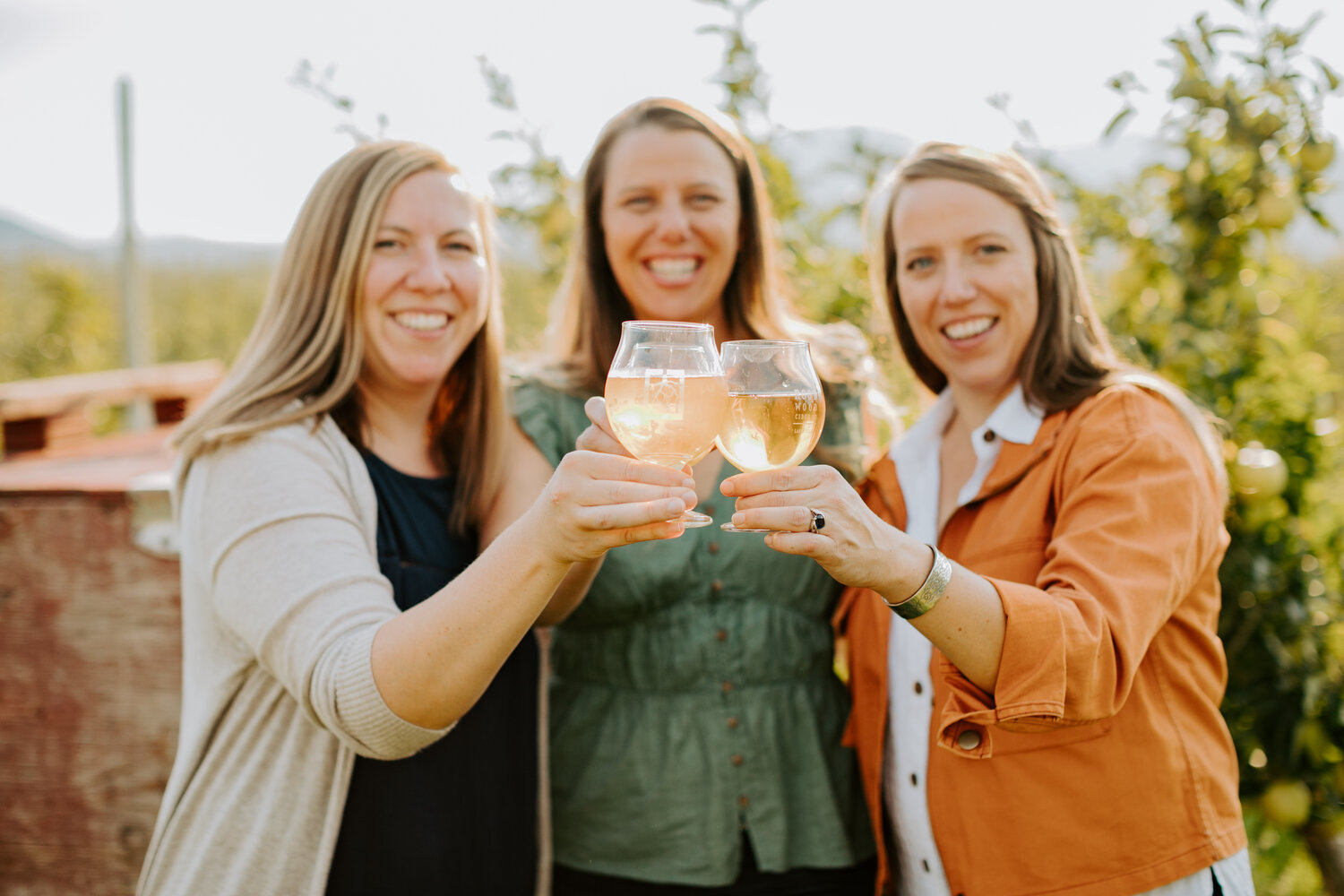


Amid the rows of their family’s Manson orchard, Rootwood Cider Company stands as more than a cidery—it’s a living testament to heritage, innovation, and the power of family. Sisters Anna Koenig Caddey, Kate Koenig Howard, and Emily Koenig McLean have carried forward their family’s apple-growing legacy, transforming it into a vibrant, community-focused cider company that blends tradition with modern craft.
The story of Rootwood Cider began long before the first bottle was ever corked. The Koenig family’s roots in apple farming stretch back to the early 1910s, when their ancestors first settled in Wenatchee and later moved to the Manson area. Over generations, the family established orchards, weathered the changing tides of the apple market, and cultivated a deep connection to the land.
“Our roots actually started in Wenatchee, maybe in the early 1910s,” Anna recalls. “And then part of the family moved up to the Manson area and established more orchards. Our dad, Jim, took over some of the family orchard in the early 80s, and my parents have been farming since then up here.”
This legacy of farming is not just a backdrop—it’s the foundation upon which Rootwood Cider is built. The sisters grew up immersed in the rhythms of orchard life, learning the value of hard work, resilience, and community.
As the apple industry evolved and market pressures mounted, the Koenig family decided to make some changes of their own.
“The market started to change, and we decided to look at options for still continuing to grow apples, but maybe diversify our orchard a little bit and our operations,” Anna explains.
The answer came in the form of cider apples—varieties grown not for the supermarket, but for their unique flavors and fermentation qualities.
“We now grow about five acres of cider-only apples, so non-commercial apples that would never get packed or sold commercially. We just grow them for cider,” Anna says.
In August 2015, Rootwood Cider officially opened its doors, marking the beginning of a new era for the family. The cidery became a way to honor their heritage while embracing innovation, offering the next generation a meaningful way to stay connected to the land.
Running a family business is never without its challenges. For the Koenig sisters, the key has been recognizing each other’s strengths and finding ways to collaborate effectively.
“It’s always a balancing act,” Anna admits. “We all have kids that are near the same age, so it’s been challenging on that front, but we’ve found ways to use our strengths in different capacities. Kate has done the primary cider making for the last four years, I deal with marketing and social media, and Emily, who lives in East Wenatchee, is less involved day-to-day but still part of the team.”
Decision-making, they joke, can be a lengthy process.
“It takes us a long time to make decisions, because we’re always trying to be unanimous,” Kate said. “But we all have a common goal—wanting to preserve agriculture here and share it so it can be appreciated.”
Rootwood Cider’s philosophy is as much about place as it is about product. The sisters are committed to using their own apples and sourcing locally whenever possible, creating ciders that reflect the unique terroir of the region.
“We like to use our apples and apples that are close by, if we don’t have a certain variety,” Kate said. “We have some estate ciders, and if there’s a different kind in town, we like to work with local farmers. We have single varietal ciders that showcase a particular apple, and blends for balance in flavor.”
Innovation is part of the mix, too.
“We incorporate some modern practices, like adding cherry or hops, but always with full fruit and always making sure the dominant element is apple,” Anna said. “We’re not trying to make something that replicates a soda. We want to celebrate the apple.”
The process at Rootwood is a blend of tradition and modernity. Pressing happens once a year with a mobile press, and the juice is fermented to dryness before being matured, blended, carbonated, and packaged.
“We don’t own a press—we hire a mobile press, which is pretty cool,” Kate said. “We ferment everything to dryness, then store it in large vessels. As we want to make batches throughout the year, we blend, carbonate, and package.”
The result is a range of ciders that are clean, crisp, and balanced.
“The number one goal is to make balanced cider profiles so you can taste everything,” Anna said. “We really strive for balance in our ciders.”
Like any small business, Rootwood Cider has faced its share of hurdles—from learning the intricacies of cider making and business management to navigating inflation and the challenges of the pandemic. The sisters had to relocate their tasting room from downtown Manson to their production facility, a move that ultimately strengthened their connection to the orchard and their customers.
“We were worried it would be hard to get the word out that we had moved, but it’s been a really positive change,” Anna said. “People are happy to come up and be surrounded by the orchard and make that connection.”
The rewards, they agree, far outweigh the challenges.
“It’s so rewarding to see the connection of our family’s farming and seeing people experience and sometimes have a revelation about cider,” Anna said. “When people learn about it and bring their friends, that’s the coolest thing.”
For Kate, the joy comes from seeing people enjoy the fruits of their labor.
“Making a product out of our very own apples and watching people enjoy it in our space is very rewarding,” she said.
Rootwood Cider is more than a business—it’s a gathering place for locals and visitors alike. The sisters take pride in creating an approachable, welcoming atmosphere where everyone can find something to enjoy.
“We pride ourselves on being very approachable and welcoming,” Anna said. “If someone has never tasted cider, we can help guide them in finding something they like.”
The tasting room offers flights, bottles to go, and a cider club, along with light bites like charcuterie and snacks. It’s a place where teachers gather on Friday afternoons, couples celebrate milestones, and friends reconnect.
As for the future, the sisters are taking a measured approach to growth.
“We’re purposefully slow, or intentionally slow,” Anna said. “We’re working on expanding our regional distribution, finding spots in local grocery stores, and growing our self-distributed, regional approach.”
But at the heart of it all is a commitment to their roots—both literal and figurative.
“We love to see people from the Wenatchee Valley and beyond,” Anna said. “The tasting room is always the best place to get the most variety and experience what we’re all about.”
The name "Rootwood" carries a special significance for the Koenig sisters and their family business.
“It’s a fictional name or made-up name, but it does kind of have two purposes,” Anna said. “The idea behind grafting, where you’re using an existing root stock and kind of changing the variety of tree by adding little pieces of wood, or scions, is a pretty literal translation of how we changed some of our apple varieties over to cider varieties. But I’d also say the name harkens to our deep roots and history in farming. We always say it’s a little bit of our story—preserving the traditions of farming, but also trying to innovate and diversify.”
Grafting is a common and important practice in fruit tree farming. It involves taking a piece of wood (called a scion) from one tree and attaching it to the rootstock of another. This allows growers to change the variety of fruit produced by an established tree without having to plant a new one from scratch.
“It is fairly common,” Anna said. “The reasons why somebody might do that is if the spacing and the correct root stock and irrigation are all set up in the orchard already, you can go in and do grafting and get a crop of apples in a quicker turnaround, without having to change all of the infrastructure and plant a new tree. It’s quicker. We were able to use an existing block of Fuji trees on our first kind of grafting. The type of Fujis we had were not viable in the commercial market anymore, so we used a block of Fujis to graft in cider varieties. Over time, we’ve tried out about 12 different varieties and settled on about six that work well for cider.”
Rootwood is a name that honors both the literal process of grafting—using roots and wood to create something new—and the family’s deep agricultural roots. Grafting itself is a practical, widely used technique in fruit tree farming that allows for innovation and adaptation while preserving the foundation of the orchard.
Rootwood Cider Co. stands as a testament to the power of family, tradition, and the willingness to adapt. The Koenig sisters have taken their family’s legacy and infused it with new life, creating a business that honors the past while looking to the future.
For visitors to Manson, a stop at Rootwood Cider is more than a tasting—it’s an invitation to become part of a story that’s still being written, one bottle at a time.
Quinn Propst: 509-731-3590 or quinn@ward.media.


Comments
No comments on this item Please log in to comment by clicking here